
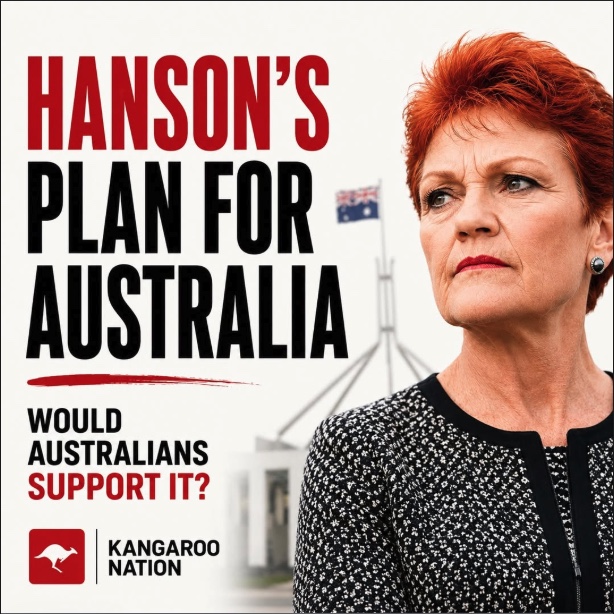
Pauline Hanson is presenting One Nation as a government-in-waiting, moving beyond protest politics to outline a broad program on migration, energy, taxation, housing and public spending.
The platform has attracted voters frustrated with the major parties, but it also raises difficult questions about cost, legal implementation and the trade-offs behind headline promises. The clearest way to assess it is to separate the party’s stated goals from the practical decisions a government would have to make.
MIGRATION AND POPULATION
One Nation has argued for sharply lower migration, with senior figures promoting a period of zero net migration. Supporters say this would reduce pressure on housing, infrastructure and public services. Critics respond that migration is only one part of the housing shortage and that a sudden reduction could worsen labour gaps in health care, construction, agriculture and other industries.
Net migration is also not the same as stopping every arrival. It measures people entering for the long term minus those leaving. Delivering a zero figure would require decisions about skilled visas, international students, family reunion and temporary workers, each with consequences for employers, universities and families.
ENERGY AND NET ZERO
The party rejects Australia’s current net-zero direction and wants a stronger role for coal, gas and domestic resource development. Hanson has also proposed a new approach to oil and gas in which the Commonwealth would take an equity stake in some future projects and receive royalties from new production.
Supporters argue that more supply and different market rules could improve energy security and lower prices. Opponents say abandoning emissions commitments would increase climate risk, discourage some investment and create uncertainty for industries already planning a transition. Any government would also have to work through state responsibilities, existing contracts and international obligations.
TAX, HOUSING AND FAMILY POLICY
One Nation supports income splitting for couples with dependent children, allowing family income to be divided for tax purposes. The party says this would leave more money with families and reduce reliance on subsidised childcare. The benefit would not be equal for every household: it is generally larger when one partner earns much more than the other, while single-parent and similar-income households could gain less.
The party has also proposed 30-year fixed-rate mortgages at 5 per cent through Australia Post, funded by redirecting money from the Housing Australia Future Fund. Economic analysts have questioned whether the cap would meet demand and whether taxpayers would carry interest-rate and housing-market risk.
NDIS AND GOVERNMENT SPENDING
Hanson has promised large reductions in Commonwealth spending and changes to programs including the National Disability Insurance Scheme. There is broad agreement that fraud, price inflation and poor administration should be addressed. The dispute is over whether very large savings can be achieved without reducing legitimate support.
The NDIS is an individualised disability program, so slogans about “waste” must be translated into rules covering eligibility, plan reviews, provider prices, compliance and appeals. Families and participants would need detail before knowing how proposed savings affect daily support.
CAN THE NUMBERS ADD UP?
ABC analysis of One Nation’s economic agenda has highlighted the scale of several commitments, including higher defence spending, family tax changes, mortgage support and zero net migration. Opposition modelling has claimed a very large long-term cost, while One Nation disputes those estimates and argues that spending cuts and policy redesign would offset new commitments.
Both sides’ claims need scrutiny. Campaign costings are strongest when they publish assumptions, time periods and independent review. A credible governing program must explain not only what it will abolish, but the transition costs, the people affected and the legislation required.
THE CHOICE FOR VOTERS
One Nation’s appeal is built on a promise of decisive change. For supporters, that is the point. For undecided voters, the central question is whether the program can deliver lower costs and stronger services without creating larger fiscal, labour-market or investment problems.
The next stage should be detailed, independently costed policies. Australians can then judge the plan on evidence rather than on either enthusiasm or alarm.
Sources: ABC News · ABC News · ABC News



Leave a Reply