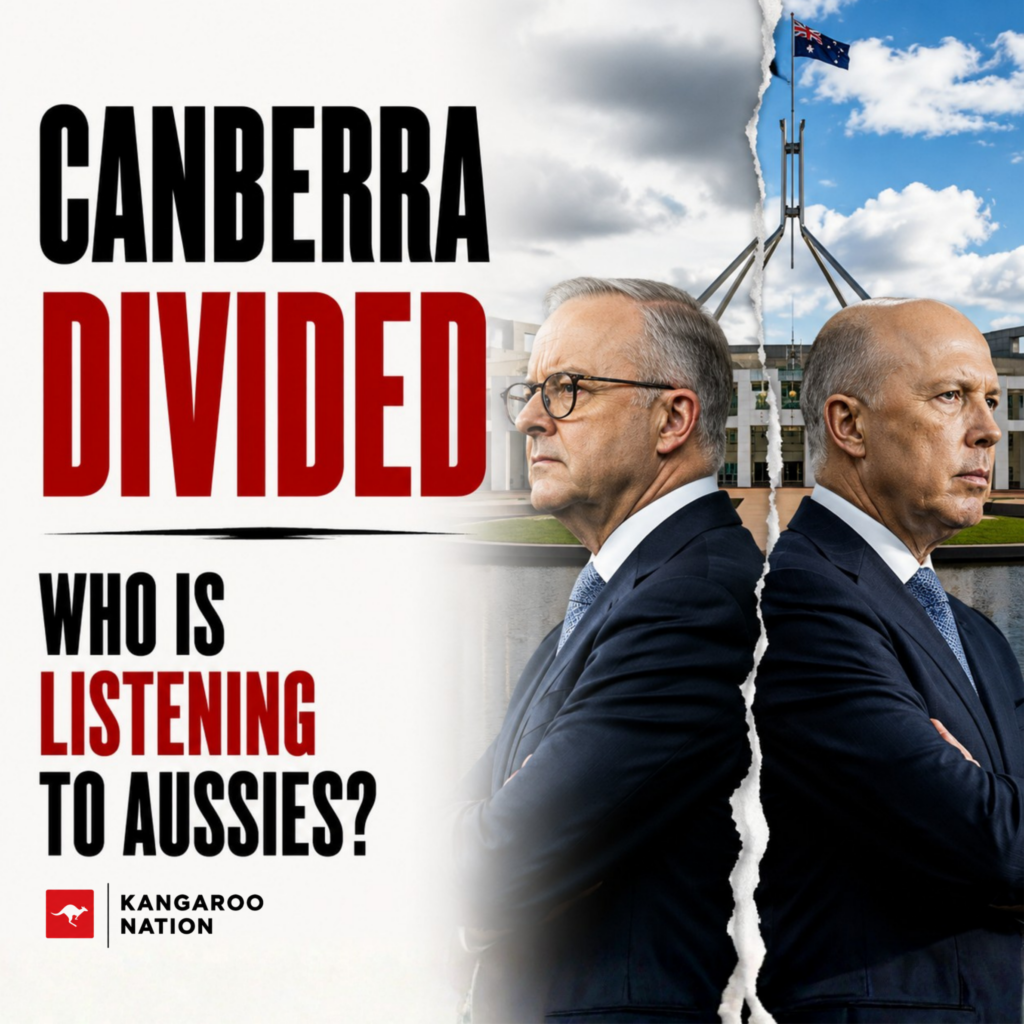
Editor’s note: The supplied artwork uses a stylised figure resembling former opposition leader Peter Dutton. The Coalition is led by Angus Taylor in 2026. The image illustrates Australia’s longer-running political divide and is not a current leadership portrait.
Australia’s political argument is louder than ever, but a growing number of voters appear unconvinced that Canberra is listening. Cost-of-living pressure, housing insecurity, stretched services and distrust of political institutions have combined into a deeper problem: many Australians do not simply disagree with government decisions — they feel they have little influence over how those decisions are made.
That frustration is reshaping the contest between Prime Minister Anthony Albanese’s Labor government, the Coalition under Angus Taylor, One Nation, the Greens and a widening field of independents. The result is a more fragmented electorate in which traditional party loyalties are weaker, protest votes are easier to mobilise and every major party faces a credibility test.
A warning beneath the political noise
An ABC report on national voter attitudes found that about three in four Australians believed politicians focused on short-term gains and re-election, while many thought political leaders mainly served themselves or vested interests. Those findings do not prove that every voter has abandoned the major parties, but they help explain why political messages that once worked automatically are now being questioned.
The Australian National University’s March 2026 ANUpoll, based on 3,662 adults, also recorded economic strain, pessimism and low political trust. At the same time, the survey found broad support for government playing an active role in areas such as health, education, income security and the economy. That combination matters. Many voters are not asking government to disappear; they are asking it to deliver fairly, explain its choices honestly and show that ordinary people have a meaningful voice.
The OECD’s 2026 trust survey adds another dimension. Its Australia country note identified large gaps in trust between people who believe they have political agency and those who feel they do not. In plain terms, confidence falls sharply when citizens think the system would ignore them even if they spoke up.
Why the cost of living dominates
For households, political trust is tied to lived experience. Inflation statistics can improve while rent, mortgage repayments, insurance, groceries, energy and transport remain painfully expensive. A government may point to progress in the national data, but a family that cannot build savings or find secure housing will judge the economy by what remains after the bills are paid.
Labor’s challenge is to turn policy announcements into visible improvements. Measures involving tax, Medicare, housing supply, wages or energy will be judged less by the size of the headline than by whether people can obtain an appointment, afford a home, pay for essentials and feel more secure about the next year.
The Coalition’s challenge is different but just as difficult. Angus Taylor must persuade voters that the opposition has a credible alternative, not simply a list of grievances. The Liberal Party describes Taylor as the current Leader of the Opposition and has centred its message on living standards, taxation and economic management. But rebuilding trust also requires the Coalition to explain what it would fund, what it would cut and how its proposals would affect renters, mortgage holders, regional communities and younger Australians.
The rise of political fragmentation
Disillusionment does not move in one direction. Some dissatisfied voters are turning to One Nation, particularly where immigration, national identity, energy policy and distrust of institutions dominate the debate. Others are moving towards the Greens or community independents because of housing, climate policy, integrity and frustration with the two-party system. Many voters remain undecided or shift between parties from poll to poll.
Recent public polling has shown the Coalition and One Nation competing intensely for voters outside Labor’s base, while Labor has retained a strong overall position in several surveys. Polls are snapshots, not election results. Different firms use different samples, weighting methods and preference assumptions, and Australia’s compulsory preferential voting system means a primary-vote surge does not translate automatically into seats.
Still, the political message is unmistakable: neither Labor nor the Coalition can assume that dissatisfied voters will eventually “come home”. Loyalty must be earned again.
Two Australias — and many more within them
Political debate often reduces the country to inner-city progressives and outer-suburban or regional conservatives. The reality is more complicated. A nurse in western Sydney, a small-business owner in regional Queensland, a renter in Melbourne and a farmer in Western Australia may face different pressures, yet all can share the sense that decisions are made far away by people who do not experience the consequences.
Geography affects access to health care, transport, education and employment. Age shapes the experience of housing and retirement. Income determines how easily a household can absorb higher prices. Cultural background and migration experience influence how people hear arguments about population and social cohesion. Good policy must recognise those differences without turning Australians against one another.
That is where political language matters. Leaders can acknowledge strain without exaggerating it, debate immigration without blaming migrants, discuss security without manufacturing fear and challenge opponents without treating their supporters as enemies. A democracy cannot remove disagreement, but it can refuse to make division the business model.
What genuine listening would look like
Listening cannot mean another survey whose results disappear into a report. It should produce visible changes in how decisions are developed and explained.
- Explain the trade-offs. Governments should say who pays, who benefits, when results are expected and what could go wrong.
- Publish delivery scorecards. Major promises on housing, health, infrastructure and cost-of-living relief should be tracked with clear milestones and independent data.
- Strengthen political integrity. Transparent lobbying records, stronger donation disclosure and effective truth-in-political-advertising rules would help voters judge who is influencing policy.
- Take consultation beyond Canberra. Regional forums, citizens’ panels and local hearings should include people who do not belong to political parties or professional advocacy groups.
- Respond to evidence. When a program is failing, leaders should correct it without pretending that changing course is weakness.
These steps would not end disagreement. They would make disagreement more useful by connecting it to evidence, consequences and accountability.
A test for every party
Labor must demonstrate that incumbency can deliver practical improvements and that consultation is more than a communications exercise. The Coalition must show it has learned from electoral defeats and can offer detailed alternatives rather than nostalgia or anger. One Nation must prove that protest messages can become workable policy under parliamentary scrutiny. The Greens and independents must explain how ambitious proposals would be financed and implemented across a diverse federation.
Voters also carry responsibility. Social media rewards certainty, outrage and humiliating the other side. Democracy requires something slower: checking sources, separating reporting from commentary, understanding preference voting and accepting that no serious national policy is cost-free.
The real question for Canberra
The most important divide may not be Labor versus Coalition, left versus right or city versus country. It may be the divide between people who believe the political system can respond to them and people who believe it will not.
Closing that gap will take more than a new slogan or a sharper attack in Question Time. It will require measurable delivery, honest explanation, stronger integrity rules and a willingness to hear uncomfortable evidence. Australians do not expect every decision to go their way. They do expect their government and opposition to understand the pressures they live with and to show how national choices connect to everyday life.
Canberra is divided. The public is fragmented. The party that listens most seriously — and proves it through results — will have the strongest claim to govern.
More video coverage
- ABC News interview on Pauline Hanson, One Nation and the changing political landscape
- 7NEWS Australia long-form interview on One Nation’s rise
Sources
- ABC News — Disillusioned voters and political trust
- Australian National University — March 2026 ANUpoll
- OECD — 2026 trust survey: Australia country note
- Australian Bureau of Statistics — Trust in national government
- YouGov — July 2026 federal voting-intention analysis
- ABC News — Coalition strategy and One Nation voters
- Liberal Party of Australia — Leadership history


Leave a Reply