
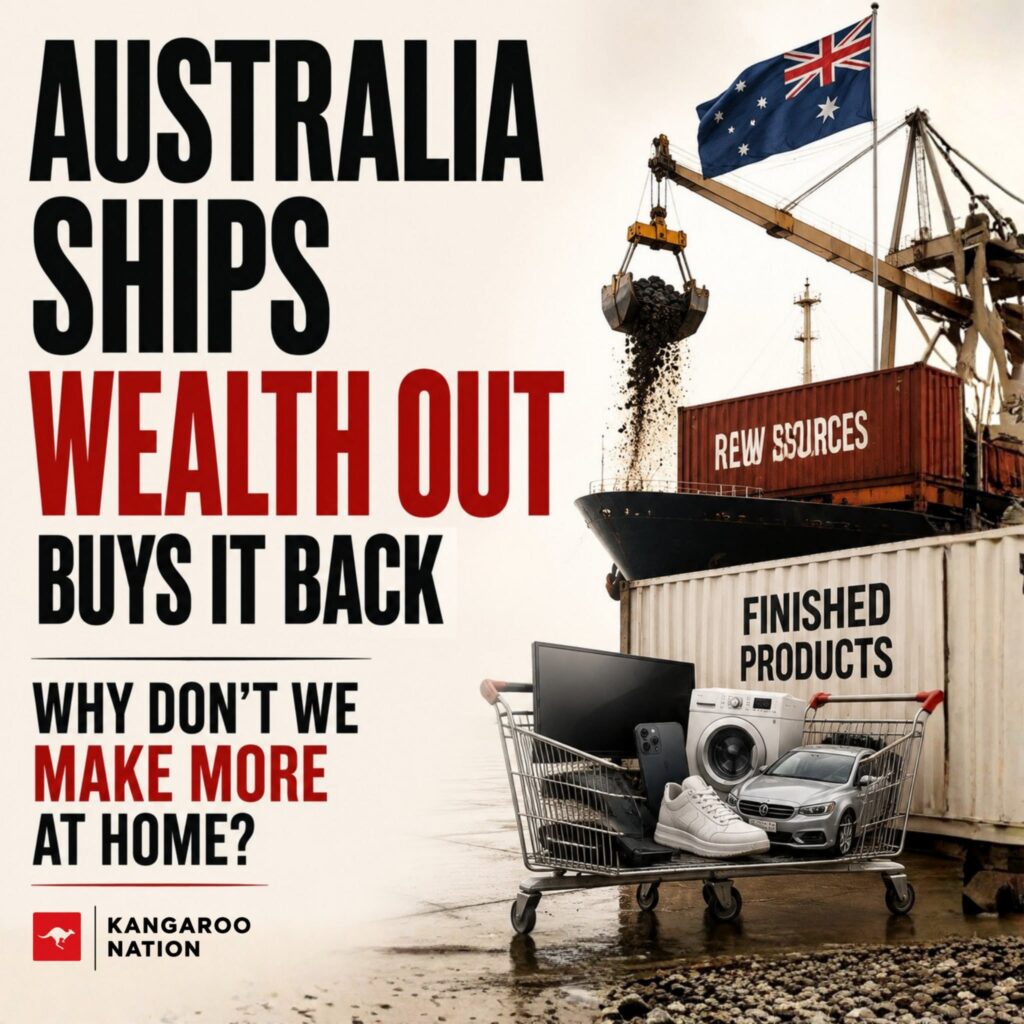
Australia’s strong resource exports are renewing an old economic question: should the country process more of its minerals and energy at home instead of exporting raw materials and importing higher-value finished products?
Resources and energy export earnings are forecast to remain exceptionally high, supported by iron ore, liquefied natural gas and a growing group of critical minerals. Yet manufacturing’s share of the economy has fallen over decades, leaving Australia dependent on overseas factories for many products built from materials mined locally.
A resources powerhouse
Federal industry forecasts put resources and energy export earnings at about A$405 billion in 2025–26 and A$416 billion in 2026–27. Iron ore is expected to remain the largest contributor, while lithium and other critical minerals are increasingly important to batteries, renewable energy, defence and advanced technology.
Those exports support jobs, government revenue and regional communities. Selling commodities into large global markets can also be more efficient than trying to manufacture every product domestically.
Where the value is added
The criticism is that much of the profit and skilled work occurs after extraction. Refining ore, producing chemicals and components, assembling machinery and developing technology can generate more value than shipping an unprocessed commodity.
When Australia later imports finished goods, consumers and businesses pay for the processing, intellectual property, transport and margins created elsewhere. Recent supply disruptions have also shown the risk of relying heavily on overseas producers for essential goods.
Why domestic manufacturing is difficult
Processing and manufacturing require reliable energy, water, infrastructure, finance, specialised workers and customers willing to sign long-term contracts. Australian wages and construction costs are high, and many international competitors operate at a scale that is difficult to match.
Some mineral-processing projects also face environmental challenges. Refining can be energy-intensive and create waste that must be managed safely. Building every stage of a supply chain locally is not automatically economical or environmentally preferable.
A targeted approach
The strongest case may be for selective investment rather than trying to replace all imports. Australia can focus on sectors where it has a durable advantage: critical-mineral processing, clean-energy equipment, defence supply chains, medical products, food technology and specialised machinery.
Government policy can help through research, training, infrastructure and predictable rules, but public support should be transparent and tied to measurable outcomes. Projects that depend permanently on subsidies without building capability or exports can become expensive.
The strategic question
The debate is ultimately about resilience as well as profit. A country does not need to manufacture everything, but it must decide which capabilities are too important to lose and where local production can compete.
Australia’s mineral wealth provides an opening. Turning more of that wealth into technology, skilled employment and finished products will require patient investment and a realistic assessment of energy costs, scale and global demand.
Sources: Australian Department of Industry, Science and Resources · Australian Parliament record via OpenAustralia



Leave a Reply