Australia has again taken control of the Commonwealth Games medal table, but the familiar “sporting nation” explanation only tells part of the story. The results reflect decades of targeted investment, a deep club system, world-class swimming and a Games program that strongly matches Australia’s competitive strengths.
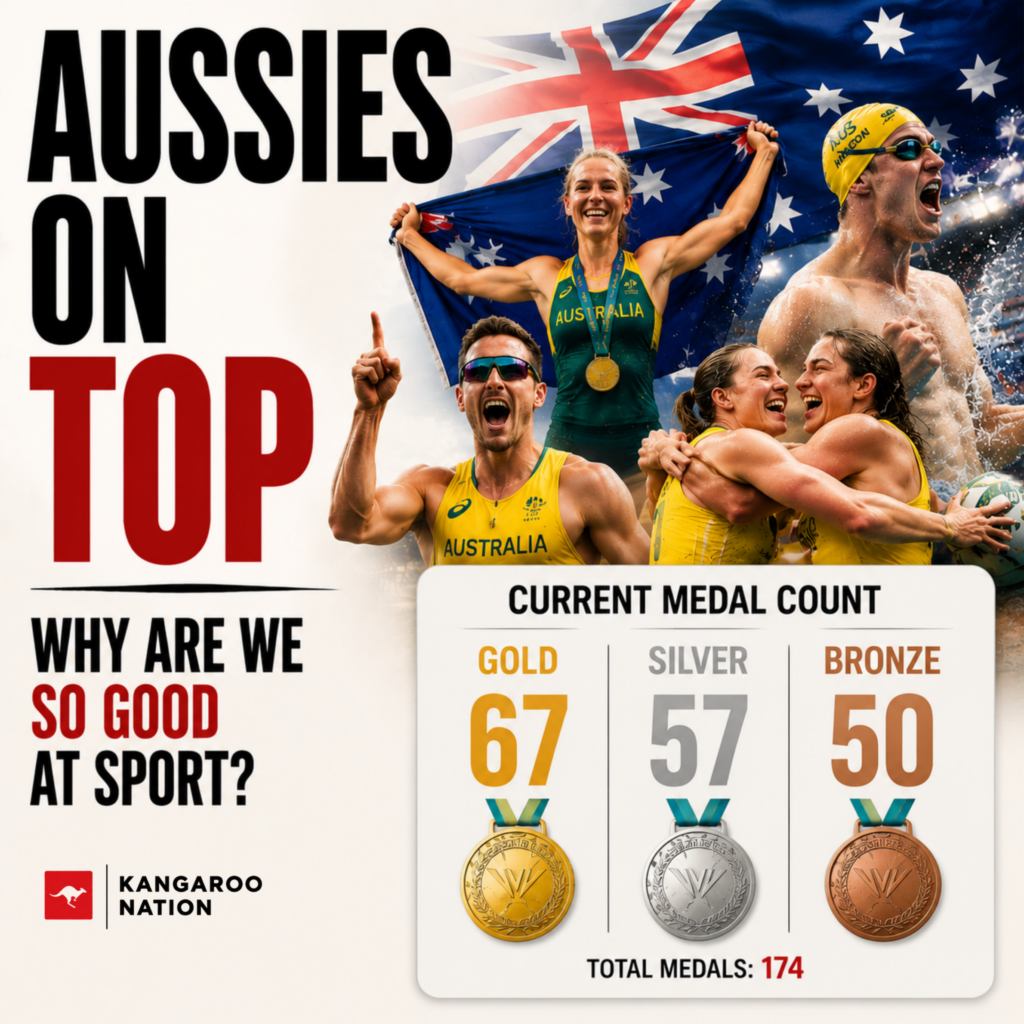
At the time of publication, the official Glasgow 2026 table lists Australia first with 65 gold, 41 silver and 52 bronze medals—158 in total. Final-day events can still change those numbers.
Editor’s note: the promotional artwork supplied with this report contains an illustrative medal count that differs from the official live table. The figures in this article use the Glasgow 2026 results page at publication time.
The pool is Australia’s greatest advantage
Swimming and para swimming are the clearest reason for the gap. Australia has collected 76 medals in the pool, including 37 golds. That is close to half of the country’s total medal haul and more than half of its gold medals.
This is not a sudden burst of form. Australia has an unusually mature swimming ecosystem: community pools, school programs, professional coaches, strong domestic championships, sports-science support and a national team accustomed to racing at Olympic and world-championship level. When a Commonwealth Games program offers many swimming events, Australia arrives with medal contenders across strokes, distances, relays and para classifications.
Success is spread beyond swimming
The official table also shows 34 Australian medals in athletics and para athletics, 20 in track and para cycling, nine in artistic gymnastics, six in boxing and four across 3×3 and wheelchair basketball. That breadth matters because it prevents the campaign from depending on one generation of swimmers.
Australia’s best sports generally combine a large participant base with a clear pathway from local clubs to state institutes, national championships and international competition. Athletes do not have to discover the elite system by accident: in the strongest programs, talent can be identified, coached and supported through several stages.
The system behind the medals
The Australian Institute of Sport sits at the centre of a national network that links national sporting organisations with state and territory institutes. Its contribution is wider than coaching. At major Games it can include performance medicine, physiotherapy, strength and conditioning, nutrition, psychology, recovery, athlete wellbeing, data analysis and logistical planning.
Commonwealth Games Australia says its Green2Gold2Great program has committed up to $11.4 million during the current four-year cycle and more than $67 million since 1996. The investment is deliberately practical: equipment improvements, performance data, targeted camps, competition opportunities and specialist support designed to turn finalists into medallists.
That approach is visible in cycling, where small gains in aerodynamics, equipment setup and race analysis can decide a result by fractions of a second. It is also evident in relays, where depth, changeover practice and team preparation allow Australia to convert several strong individuals into another medal opportunity.
Women and para athletes strengthen the whole team
Australia’s sporting success is also built on the scale of its women’s programs and the integration of para events into mainstream high-performance planning. The medal table is not being carried by a narrow group of male stars. Women, para athletes and mixed teams contribute across swimming, athletics, cycling, basketball and other sports.
That matters beyond the final count. A system that creates more credible pathways gives coaches a larger talent pool and young athletes more visible role models. It also reduces the risk that investment is concentrated in only a few traditional events.
The Commonwealth Games fit Australia’s strengths
The medal table needs context. Glasgow 2026 uses a reduced program of ten sports, and several of them—especially swimming, cycling and athletics—are areas where Australia already operates at a high international level.
Australia is also one of the Commonwealth’s wealthier and more populous sporting nations. England, Scotland, Wales and Northern Ireland compete separately rather than as Great Britain, while many smaller nations cannot fund comparable facilities, athlete services or team depth.
That does not make the medals meaningless. Athletes still have to perform under pressure against Olympic and world-class opponents. But Commonwealth dominance should not automatically be treated as proof that Australia leads every sport globally. The Olympic Games provide a deeper field, and many internationally popular sports are absent from Glasgow’s streamlined program.
A culture that makes elite sport visible
Australia’s climate, outdoor lifestyle and organised club network give many children early contact with swimming, athletics, cycling and team sport. Major events receive extensive free-to-air coverage, and successful athletes become familiar public figures. That visibility helps participation, sponsorship and recruitment reinforce one another.
Culture alone, however, cannot replace access. Registration fees, travel, equipment and specialist coaching can exclude talented families. Rural athletes may need to relocate, while young people in growing suburbs do not always have enough pools, tracks or indoor facilities. Protecting future success requires investment at the community level as well as the podium end.
The next challenge is sustaining the pipeline
The Brisbane 2032 Olympics give Australia a powerful long-term target, but they also create pressure to chase medals at any cost. Athlete welfare, education, safeguarding and life after sport must remain part of the high-performance model.
The best explanation for Australia’s results is therefore not that Australians are simply born better at sport. The advantage comes from a favourable event program combined with generations of athletes, coaches, clubs, institutes, scientists, volunteers and public investment. The medals are the visible result of a system that starts years before the podium.
Video: the Commonwealth sporting movement
Video: Australia’s previous medal-table success
More video coverage
- Official Glasgow 2026 and Commonwealth Sport video channel
- Commonwealth Games Australia: Green2Gold2Great documentary series
- 7plus Glasgow 2026 coverage and replays
Sources: Official Glasgow 2026 medal table · Australian Sports Commission · Commonwealth Games Australia · ABC News medal tracker



Leave a Reply