
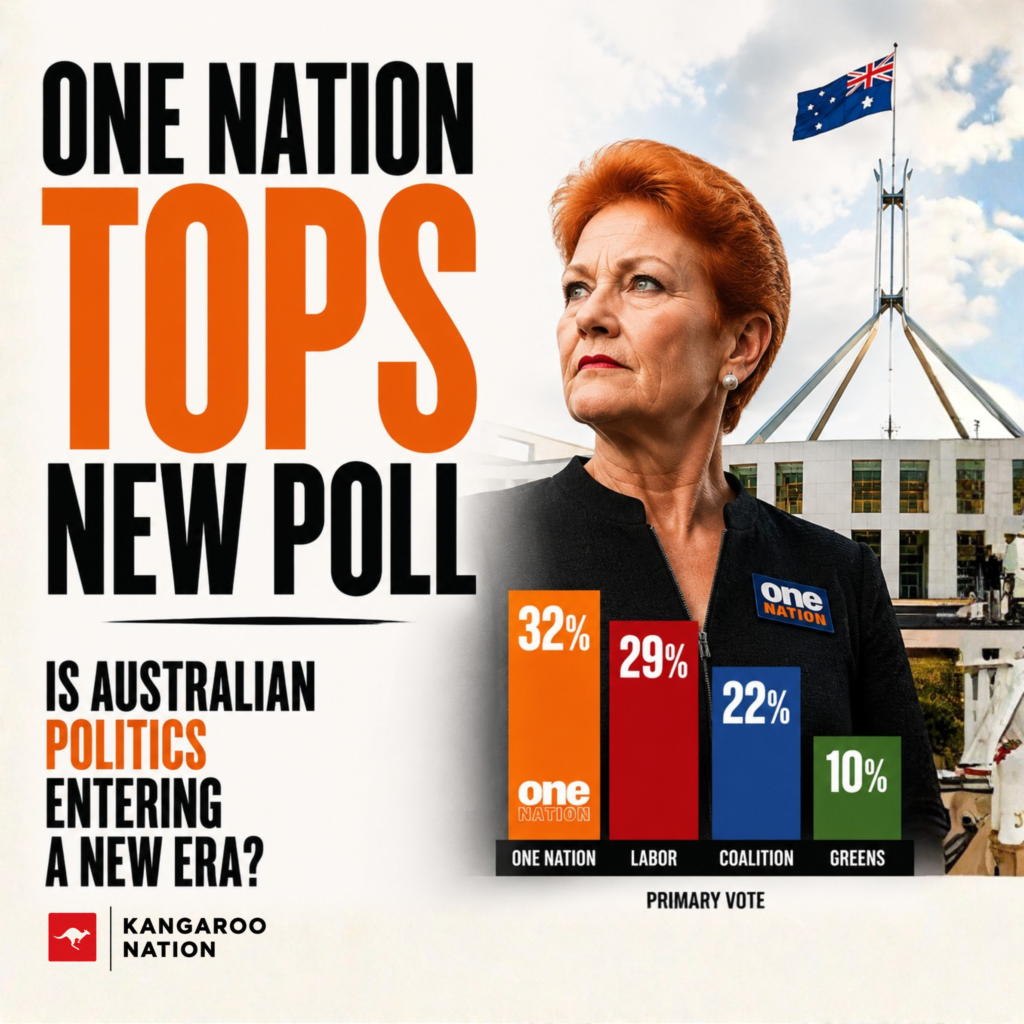
Fact-check note: The supplied artwork shows One Nation on 32%, Labor on 29%, the Coalition on 22% and the Greens on 10%. Kangaroo Nation could not match that exact four-number combination to a publicly identified national poll available at publication time. The image is used as an illustration of the wider polling debate, not as a verified statement of current voting intention.
One Nation’s rise has become one of the biggest stories in Australian politics. Pauline Hanson’s party, once treated mainly as a protest movement on the conservative fringe, is now competing with the Coalition — and in some surveys with Labor — for a far larger share of the national primary vote.
That does not mean One Nation would necessarily win a federal election if Australians voted today. Polls are snapshots, different pollsters produce different results, and Australia’s preferential voting system converts votes into seats in ways that a national bar chart cannot show. But the direction of travel is significant: support for the established major-party contest has fragmented, and millions of voters appear willing to consider alternatives.
What recent polls actually say
The most recent publicly reported Roy Morgan survey, conducted from 20 to 26 July 2026 among 1,643 electors, placed Labor on 27.5%, One Nation on 25.5%, the Coalition on 22% and the Greens on 14%. Those figures put Labor narrowly ahead on primary support while confirming that One Nation remained above the Coalition.
A Newspoll conducted in mid-July produced a different picture: Labor and One Nation were level on 30%, the Coalition was on 19% and the Greens on 12%. YouGov’s July public-data poll was more favourable to Labor and indicated that the government would comfortably defeat either One Nation or the Coalition under the preference scenarios it tested.
Earlier surveys also varied. Guardian Essential measured One Nation at 26% in late June, behind Labor on 30% and ahead of the Coalition on 23%. A May Morgan SMS poll recorded One Nation at 32%, but its other party figures were Labor 28.5%, Coalition 16.5% and Greens 11.5% — not the numbers shown together in the supplied graphic.
The lesson is not that polling is useless. It is that no single result should be treated as an election forecast, especially when the pollster, fieldwork dates, sample size and method are not shown.
Why One Nation is gaining support
There is no single “One Nation voter”. The party is drawing support from former Coalition voters, some previous Labor voters and people who had already disengaged from the two-party system. Its appeal is strongest where voters feel economic pressure, cultural change and political frustration are being dismissed or explained in language that does not match their experience.
Cost of living is central. Housing, groceries, insurance, energy and transport remain difficult for many households even when headline inflation improves. Voters who feel poorer or less secure are more receptive to parties promising a sharp break with existing policy.
Immigration is another major driver. One Nation connects population growth to housing demand, infrastructure strain and pressure on services. Those concerns deserve serious examination, but the debate also requires care. Housing shortages reflect years of planning restrictions, construction costs, land supply, infrastructure delays and inadequate social housing as well as population growth. Migrants should not be blamed for policy failures they did not create.
Distrust also matters. Research reported by the ABC found widespread belief that politicians focus on short-term electoral advantage and serve themselves or powerful interests. When voters believe the system will not respond to them, an outsider message becomes more persuasive even when the proposed policies are incomplete or uncosted.
Why the Coalition is under pressure
The Coalition’s historic role as the main conservative alternative to Labor is no longer guaranteed. Under Opposition Leader Angus Taylor, it must compete with One Nation for voters concerned about living standards, immigration, energy and national identity while also retaining moderate suburban seats needed to form government.
Moving closer to One Nation may recover some conservative voters but risk alienating others. Moving toward the political centre may help in metropolitan electorates but leave room for Hanson’s party to argue that the Coalition is not offering meaningful change. Preference negotiations add another layer: cooperation can help one side in individual contests while strengthening the rival’s claim to legitimacy.
The Coalition therefore needs more than sharper slogans. It needs a credible economic program, clear migration and housing policies, a stable position on energy and climate, and candidates capable of winning local trust.
Labor cannot treat this only as a conservative split
Labor benefits when One Nation and the Coalition divide the non-Labor vote, particularly if preferences flow unevenly. But that tactical advantage can hide a strategic warning. Some One Nation growth comes from working-class and outer-suburban voters who once saw Labor as their natural representative.
The government’s response will be judged through household outcomes: rent and mortgage pressure, access to bulk billing, secure work, wage growth, energy bills and the pace of home construction. Attacking Hanson’s rhetoric may be justified in individual cases, but it will not replace delivery.
Labor must also avoid speaking as though every One Nation supporter holds identical views. Voters can reject inflammatory statements while still believing that major parties have failed to address economic insecurity or explain difficult trade-offs.
A primary vote is not a seat count
Australia elects members of the House of Representatives in 150 local contests using compulsory preferential voting. A party can poll strongly nationwide yet win relatively few seats if its support is spread thinly or if it finishes third in many electorates.
One Nation would need credible candidates, disciplined campaigning and geographically concentrated support to convert a national surge into a large parliamentary bloc. Candidate controversies, preference flows and local campaigns could change results dramatically. A poll showing 25% or 30% nationally does not mean the party would win the same proportion of seats.
Labor also begins with the advantage of a large parliamentary majority from the 2025 election. The next election would be fought seat by seat, not as a direct national presidential contest between Albanese, Hanson and Taylor.
What voters should watch next
- Poll averages, not one headline: compare several pollsters over time.
- Method and sample: check who conducted the poll, when it was taken and how many people participated.
- Preference assumptions: One Nation-versus-Labor and Coalition-versus-Labor contests may produce different flows.
- Seat-level evidence: national support matters less if it cannot be converted into first or second place locally.
- Policy detail: judge costings, implementation and consequences, not only campaign language.
Is Australian politics entering a new era?
Possibly — but political realignments are proven at elections, not in a single poll. One Nation’s sustained rise is already changing the behaviour of Labor and the Coalition. It is influencing debate about immigration, living standards, energy, cultural identity and political trust. It may also change preference strategies and candidate selection.
Yet support can move quickly when a party receives greater scrutiny. Voters who use a poll to register dissatisfaction may make a different decision during an election campaign when policies, candidates and the prospect of government become more concrete.
The safest conclusion is also the most important: the old two-party assumptions are weaker. Australians are signalling that votes can no longer be taken for granted. Whether One Nation converts that mood into lasting parliamentary power will depend on organisation, candidates, policy credibility and the responses of its rivals.
Sources
- Roy Morgan — Federal voting intention, 20–26 July 2026
- AUNS — July Newspoll summary
- YouGov — July 2026 public-data poll
- Guardian Essential — Late-June polling
- The New Daily — Comparison of May national polls
- ABC News — Political trust and voter disillusionment
- Australian Electoral Commission — How preferential voting works



Leave a Reply