
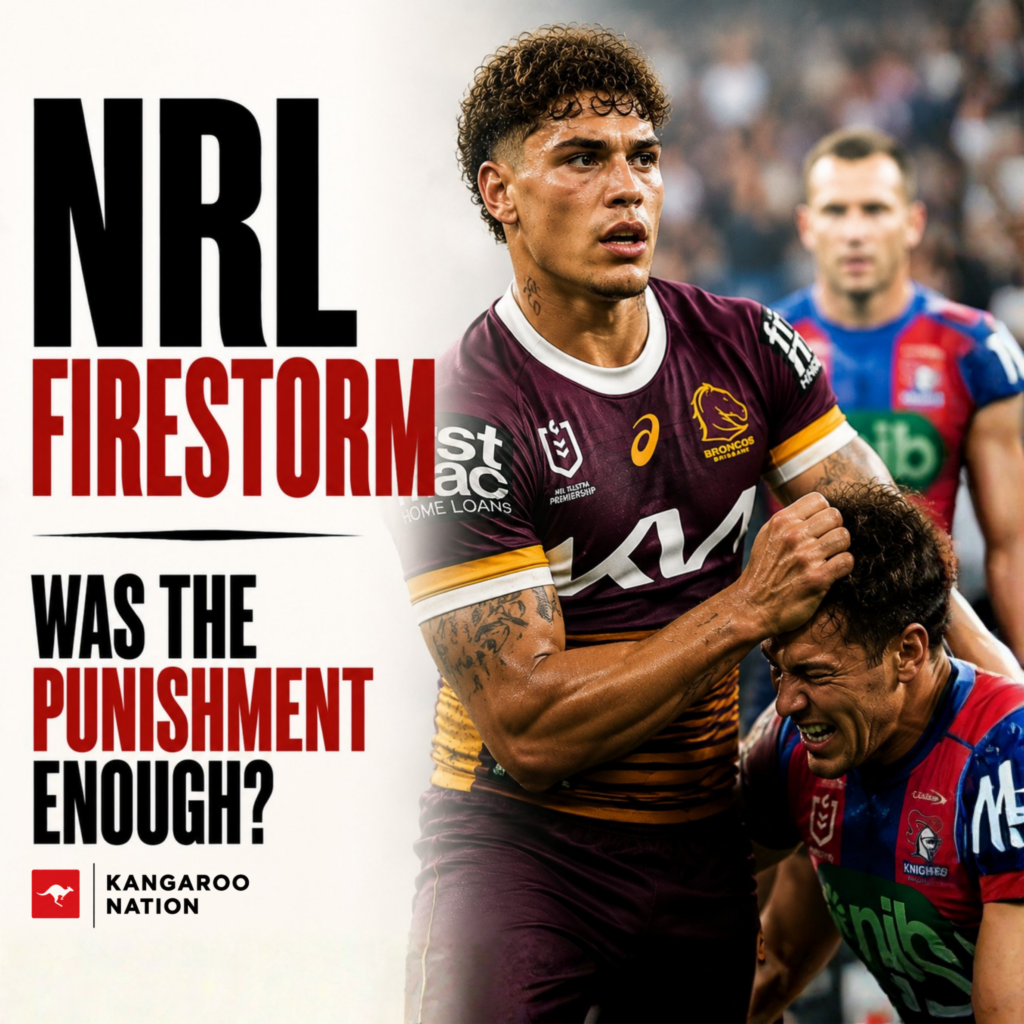
The sanctions imposed on Brisbane Broncos five-eighth Ezra Mam after a drug-driving crash triggered one of rugby league’s most difficult accountability debates. A nine-match suspension, $120,000 in combined NRL and club fines, a driving disqualification and mandatory rehabilitation measures were substantial. Yet the circumstances — an unlicensed driver, illicit drugs and injuries to people in another vehicle — left many Australians asking whether elite sport had again protected a valuable star.
This is not simply a question about how many games one player should miss. It is about what a professional league owes to victims, supporters and young people who look to athletes as role models — and what genuine rehabilitation should look like after public punishment ends.
What happened
In October 2024, Mam’s utility vehicle collided head-on with an Uber in Bardon, in Brisbane’s west. A woman and a child in the other vehicle suffered minor injuries. Mam later pleaded guilty in Brisbane Magistrates Court to driving while a relevant drug was present in his blood or saliva and driving without a licence.
The court fined him $850 and disqualified him from driving for nine months. The NRL then acted under its Code of Conduct, suspending him for the first nine Broncos matches of the 2025 season and imposing a reported $30,000 fine. Brisbane added a further $90,000 fine.
The club also required Mam to complete a safer-driving program, undertake work or study organised through its wellbeing and education department, and participate in an ongoing wellbeing-support program. Those requirements matter because a sporting penalty alone cannot address the behaviour that produced the danger.
Why critics said the punishment was too light
For critics, the most troubling element was not simply the presence of an illicit drug. Mam was also not licensed to drive, and the collision involved innocent road users. The fact that the injuries were described as minor does not erase the risk: a head-on crash can produce catastrophic consequences in seconds.
The court penalty also appeared modest to many members of the public. That intensified pressure on the NRL and the Broncos to demonstrate that being a high-profile athlete did not soften the consequences. Nine matches can feel short when measured against the potential harm, especially for ordinary Australians who expect road-safety messages to be enforced consistently.
There is another concern: fines affect people differently. A six-figure penalty is significant, but elite players can earn salaries far beyond those of most supporters. For that reason, the length of the ban, the conditions attached to his return and the evidence of behavioural change were more important than the headline dollar figure alone.
The case that the combined sanctions were meaningful
The counterargument is that punishment should be judged as a package. Mam faced the criminal court, lost his licence, missed nine premiership matches, paid combined fines of $120,000 and was subjected to club programs and public scrutiny. The NRL did not allow the Indigenous All Stars match to count towards the ban, ensuring the full suspension was served through Broncos games.
Brisbane also stopped short of terminating his contract. That decision reflected a rehabilitation model: condemn the conduct, impose consequences, then require the player to demonstrate change. Sacking a young athlete may satisfy an immediate demand for severity, but it can also remove the structure, supervision and professional support most likely to reduce the chance of another offence.
When Mam spoke publicly before his return, he accepted that respect could only be rebuilt through his actions on and off the field. That is the correct standard. An apology is a beginning, not proof that rehabilitation is complete.
Video: Mam addresses his return and responsibility
Return to football was not the end of accountability
Mam returned in Round 11 of 2025 against St George Illawarra. Playing again meant the formal suspension had ended, but it did not mean the public debate was resolved. Trust is rebuilt over years, not one press conference or one performance.
His later role in Brisbane’s 2025 premiership campaign showed why sporting organisations face difficult decisions. A gifted player can quickly become central to a team again. That makes transparent standards essential: supporters must be able to see that selection is based on a completed disciplinary process, not commercial value or on-field talent overriding misconduct.
The NRL’s 2026 judiciary record also lists Mam receiving a $1,000 fine for dangerous contact in Round 8. That was a separate on-field matter and should not be conflated with the driving offence. It does, however, underline the need to distinguish ordinary match-review penalties from the far broader responsibility imposed by the game’s Code of Conduct.
Video: Mam’s first match after serving the ban
What a credible rehabilitation test should include
A strong integrity system should ask more than whether a player has served a fixed number of matches. It should consider whether the person has complied with treatment and education, accepted responsibility without minimising the harm, engaged respectfully with those affected and maintained changed behaviour over time.
Victims should not become background characters in a celebrity redemption story. Reporting often focuses on the athlete’s career, contract and comeback, while the people inside the other vehicle disappear from view. A fair account must keep their experience at the centre of the discussion.
The league should also explain its reasoning as fully as privacy and employment law allow. Consistency is difficult when every case has different facts, but transparent principles help the public understand why one breach attracts a fine, another a suspension and another termination.
Was it enough?
There is no mathematical answer. The nine-game suspension was not trivial, and the financial and rehabilitation conditions went well beyond the court fine. It was a serious combined response. But Australians who believe the ban should have been longer have a reasonable case because the conduct created grave risk for innocent people.
The fairest conclusion is that the adequacy of the punishment cannot be measured only by the date Mam returned to the field. It must also be measured by whether the rehabilitation conditions were completed, whether the victims were treated with dignity, whether the NRL applies comparable standards in future cases and whether Mam’s conduct demonstrates lasting change.
Professional sport should allow redemption, but redemption is not entitlement. It is earned through accountability, consistency and time.
More video coverage
- ABC News — Ezra Mam apologises after the drug-driving crash
- Brisbane Broncos — Mam’s full media appearance and apology
- Nine’s Wide World of Sports — length of the NRL ban explained
- 7NEWS — Broncos coach Michael Maguire addresses the incident
Sources
- NRL — Ezra Mam breach notice
- Brisbane Broncos — club sanctions and rehabilitation requirements
- ABC News — nine-match ban and combined fines
- NRL — Mam’s apology and return conditions
- NRL — 2026 judiciary report



Leave a Reply